

Open Loom
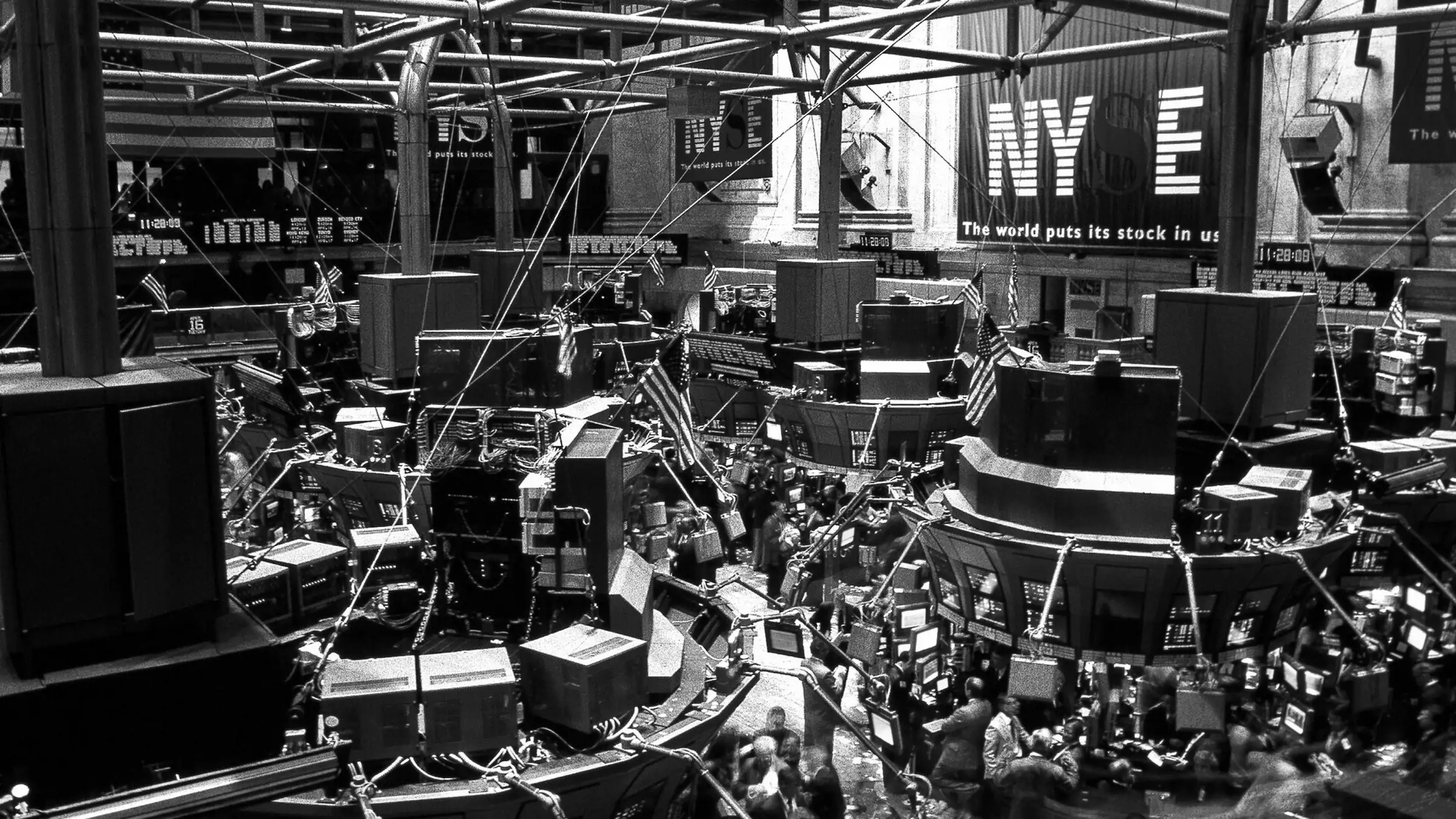
The trading floor of the New York Stock Exchange, crowded with booths, screens and traders.

Carol M. Highsmith took this public-domain photograph.

A company's story is scattered across hundreds of sources; Loom puts it all together.

Loom tracks more than 6,000 companies on the NYSE and Nasdaq. It brings their filings, earnings calls, executive and director trades, short interest and news into one dated record as they are released, and it ranks what changed, so the development that deserves your attention is the first thing you see.

Loom reads every annual, quarterly and current report a company files.

These are the documents a US public company must file with the Securities and Exchange Commission, written under legal attestation, which makes them the most authoritative record of what the company says about itself.

  • Loom takes them from the SEC as they are filed.
  • Loom holds every one of these documents in full.
  • Loom splits each filing into its sections and compares risk factors with last year's annual report and management's discussion with last quarter's.
  • The comparison runs in both directions, so a risk the company quietly withdrew is reported beside a risk it added.
  • Loom reads each new filing for the companies it tracks within minutes of its release.

Apple filed this passage in its annual report on Form 10-K on 3 November 2026.

Memory and storage shortages are critical for Apple's hardware (iPhones, Macs, iPads), and prolonged constraints could lead to production delays, higher costs, or forced price hikes that hurt demand.

“The Company is experiencing supply constraints and rising costs driven by industry-wide supply-demand imbalances for key components, including advanced semiconductors, memory and storage. The Company expects these trends to intensify for memory and storage components.”
Loom rebuilds the financial statements from the figures a company filed.

The income statement, the balance sheet and the cash flow statement say what a company earned, what it owns and owes, and where its cash went.

  • The figures come from the data companies file with each report.
  • Loom holds every figure with both the period it describes and the date it was filed.
  • Loom rebuilds all three statements on a trailing twelve-month basis, with five fiscal years of history.
  • It computes 39 measures from them, from margins and returns to a discounted cash flow model, and it flags a figure that has crossed a warning line.
  • A later restatement never changes what Loom shows for an earlier day, because each figure carries its filing date.

Loom recorded this on 26 August 2026 from the financial statements Nvidia filed.

Revenue growth slowed from 114% to 65%, a fall of 49 points.

Loom calculated it directly from the company's filed statements, and it names both periods and both figures so that anyone can check it.

Loom reads every earnings call it holds from start to finish.

Each quarter, management presents its results and takes questions from analysts, so the call shows how executives frame the business under questioning.

  • Loom reads complete published transcripts, together with scheduled reporting dates and the analysts' consensus estimates.
  • Loom holds every transcript in full.
  • Loom extracts changes in guidance, shifts in management's tone and the supply constraints that executives name.
  • It sets the guidance management gave against the results the company later filed, which builds a record of how reliable that guidance has been.
  • It lists the analysts' questions that management did not fully answer.

Apple's management said this on its earnings call for the fourth quarter of fiscal 2026, held on 2 November 2026.

Component cost inflation directly shrinks the percentage of profit Apple earns on each device sold.

“When you remove the tariff refunds from both the June and September quarter, both company and products gross margin would be down about 1 point sequentially, primarily driven by higher memory costs.”

Loom separates real decisions by executives and directors from routine paperwork.

Executives, directors and large shareholders must report their trades in the company's shares within days, and most of those trades are routine.

  • The trades come from the filings that executives and directors make with the SEC.
  • Loom holds every reported transaction.
  • Loom counts only discretionary trades on the open market towards any finding about intent, and it excludes vesting, option exercises and tax withholding.
  • Loom flags patterns such as several executives or directors selling within a short window.

Nvidia's executives and directors reported these trades on Form 4, and Loom recorded the cluster on 21 September 2026.

3 executives and directors sold shares on the open market within 14 days.

Loom calculated it directly from the filed transactions.

Loom tracks how the market is positioned around each company.

Short interest counts the shares investors have borrowed and sold in the expectation of a fall, and options and institutional holdings complete the picture of positioning.

  • The data comes from FINRA's consolidated short interest, delayed option quotes from Cboe and the SEC's quarterly Form 13F data on institutional holdings.
  • Loom holds the reported figures and their history.
  • Loom reports a jump in short interest as a finding, and it shows how crowded the short side is.
  • It shows each company's implied volatility, its put and call ratios and how many institutions hold its shares.

Loom reads every move against the market around it.

A fall in one share price can belong to the whole market, to an industry or to the company alone, and the difference matters.

  • Loom prices the S&P 500 and every US stock it covers, and it takes the VIX and the high-yield bond spread from the Federal Reserve Bank of St. Louis.
  • Loom holds price history from one hour to one year, read strictly backwards from any date.
  • Loom states whether the S&P 500 is calm or in a pullback, a correction or a bear market, and it scores fear in the market from 0 to 100.
  • For each company it separates how much of a recent move was the market's and how much was the company's own.
  • It measures each company's beta against the S&P 500, which feeds the cost of capital in its valuation.

Loom reads the news for what has not been filed yet.

News is the fastest source, and it is often the only one for something a company has not yet disclosed.

  • Company news comes from news providers, and coverage of world events comes from named outlets.
  • Loom holds the headline and summary of each item, so the publisher's page remains the fuller record.
  • Loom names the outlet behind every development it takes from the news.
  • When a world event may reach a company, Loom says plainly that the connection is its own reading, because no outlet wrote it about that company.

Loom keeps the economy in view beside every company.

Interest rates, inflation and jobs set the backdrop for every company.

  • The dates come from the Federal Reserve's meeting calendar and from the release calendar of the Federal Reserve Bank of St. Louis.
  • Loom holds past and scheduled dates as well as the series themselves.
  • Loom puts the dates the market waits for on its calendar, beside each company's next earnings report.
  • It shows how the market has moved on days like these before, and it presents those moves as history.
  • Its valuations use current market rates, and each one says which day's figures it used.

The sources become a few things you can actually review.

Each view below answers one question that a careful investor would otherwise answer by hand.

Every development becomes a finding.

Each finding carries its quote, its source, its importance and how it was established, and there are twelve kinds, from a new risk factor to a shift in management's tone.

Every company gets a reading on four things.

Loom says whether the shares are moving more than usual, whether the filings read better or worse than usual, whether the accounts have crossed a warning line and whether executives and directors are trading together.

Loom shows you where its sources disagree.

When two sources point different ways about a company, Loom shows both sides with their sources and keeps the tension visible.

Loom names the best argument the other way.

Beside the findings, Loom shows the strongest piece of evidence that cuts against them.

Loom shows what it is watching for.

For each company, Loom sets out the developments that would matter most, so you know what to look out for.

Loom keeps a record of management's promises.

Guidance from earnings calls is checked against the results filed later, and results are set against the analysts' consensus.

Loom maps which companies move which.

Companies name their suppliers, customers and risks in their filings, and Loom joins those mentions into a map of exposure.

Loom ranks each company against its peers.

The rankings use measures from published research, and each one names the paper it comes from.

Loom publishes its own track record.

Loom measures what happened to the shares after past findings of each kind, and it marks every sample that is too thin to trust.

Loom watches your portfolio for you.

Your holdings appear first on every page, and Loom emails you when something changes in a company you own.

You can search every document Loom holds.

Full-text search returns the matching passage from every filing and transcript in the record.

The terminal puts every figure on one screen.

The terminal is a dense working view for readers who want as many figures as possible in front of them at once.

A company page puts the figures, the valuation and the price side by side.

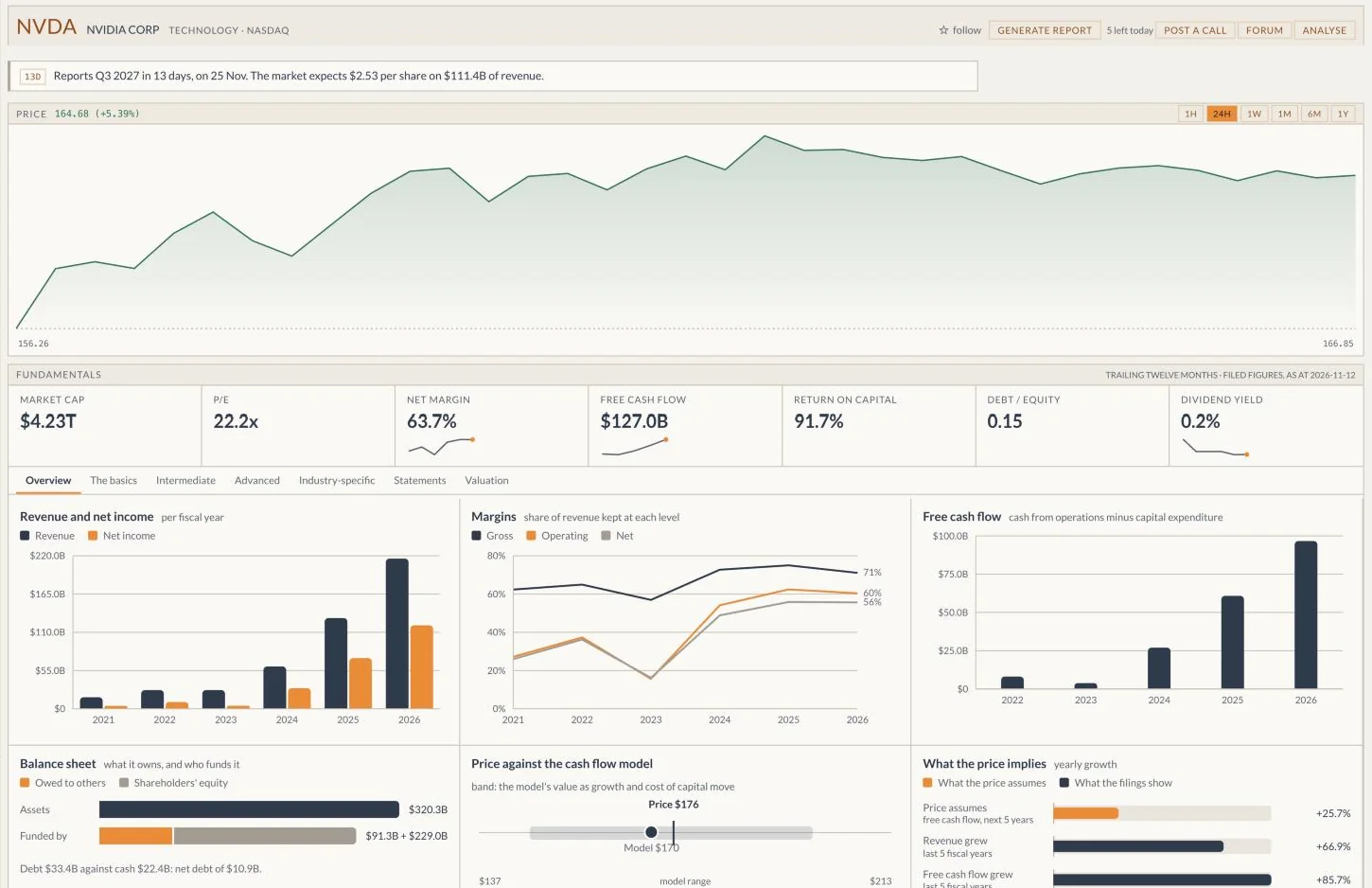
Loom's company page for Nvidia, with the price chart, key figures, revenue and net income, margins, free cash flow, the balance sheet and the price against the cash flow model.
This is Nvidia's company page on loomintel.me, captured on 12 November 2026.
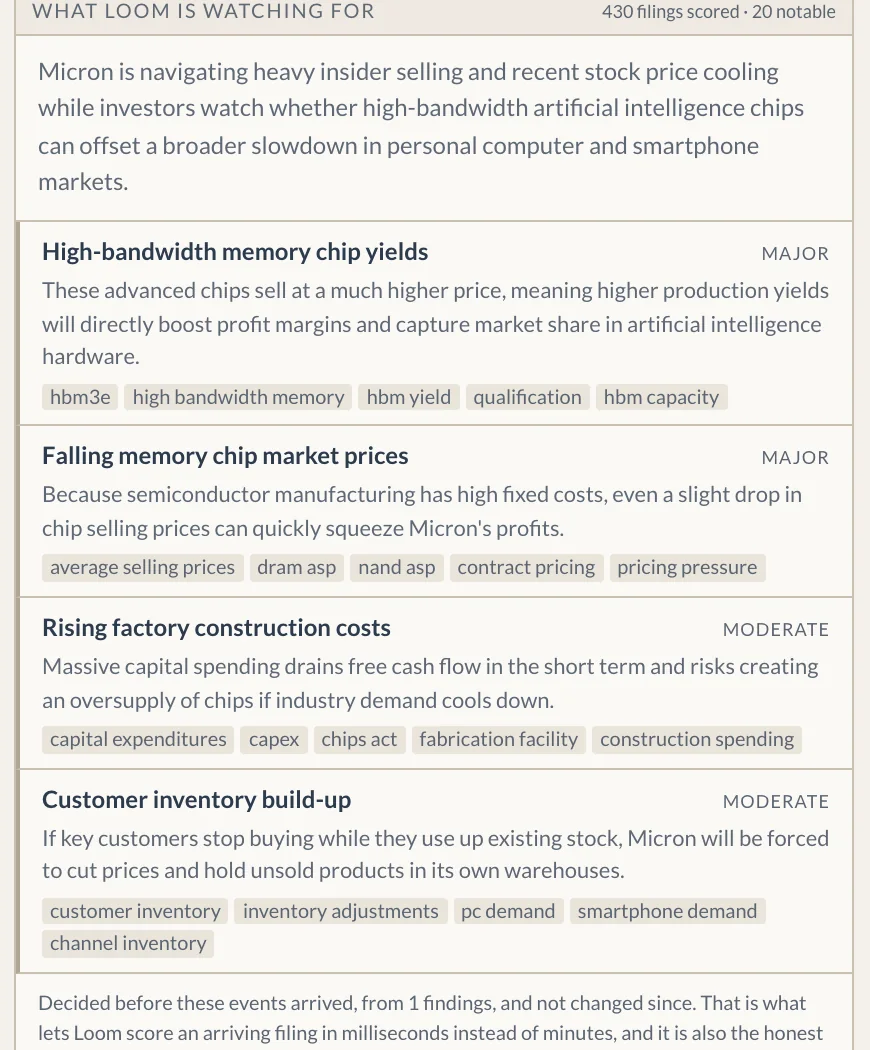
A Loom panel listing developments that would matter for Micron, such as high-bandwidth memory chip yields and falling memory chip prices.
Loom decided what it was watching for at Micron before the next filing arrived.

Your own tools and AI assistants can read the same evidence.

Developers create read-only API keys in Loom and query findings, filing changes, contradictions, fundamentals and market data over HTTP. An MCP server with 15 tools gives assistants such as Claude and Cursor the same evidence, and every query accepts a past date.

Software receives Loom's evidence, and the conclusions stay with whoever uses it.

A list of Loom's evidence API endpoints, including capabilities, coverage, the full record for a ticker, findings and filing changes.
This is part of the endpoint list on Loom's developer page.

You can see what Loom has read about a company you follow.

You create an account with your email address, answer a short survey about how you invest, and then search for any company listed on the NYSE or Nasdaq.