Every finding in Loom leads back to its document. You never have to take Loom's word for anything.
A conclusion you cannot check is a conclusion you have to trust. Each finding carries its source, its passage and an honest account of how it was reached, so you can decide how much weight it deserves.
Every finding has seven parts, and each part lets you check the one before it.
This real finding comes from Apple's annual report for fiscal 2026, exactly as Loom's evidence API served it. Each note on the right highlights the part it describes.
1
Memory and storage shortages are critical for Apple's hardware (iPhones, Macs, iPads), and prolonged constraints could lead to production delays, higher costs, or forced price hikes that hurt demand.
2
“The Company is experiencing supply constraints and rising costs driven by industry-wide supply-demand imbalances for key components, including advanced semiconductors, memory and storage. The Company expects these trends to intensify for memory and storage components.”
Loom read it from one filing that had no predecessor on file, so it says the risk reflects this filing's own framing and has not been measured against an earlier report.
6
Loom classed it as a new risk factor of major importance. The document points negative.
7
Across 186 measured cases of a new risk factor, the shares moved 5.2% against the direction the document pointed, relative to the market, on average over the following week, and they moved in the documented direction 44% of the time against 56% by chance.
Some findings can be recomputed with a calculator, and others are judgements. Loom tells you which is which.
Both kinds can be useful, and they deserve different amounts of trust. The list runs from the most checkable kind of finding to the least.
The orange bars measure how directly you can check a kind of finding against its source. Five bars mean you can recompute it yourself from the filing, and one bar means it is a judgement about language.
Loom calculates these directly from filed figures, so you can check them against the filings yourself.
Loom calculates a shift in the filed numbers directly from the company's statements, and it names both periods and both figures so that you can check the change.
Loom calculates executive and director trading directly from filed transactions, leaving out routine vesting, option exercises and tax withholding.
Loom reports a jump in short interest directly from FINRA's published figures.
Loom finds this by comparing two filings, so you can check both texts yourself.
Loom finds a new or withdrawn risk factor by comparing two filings, so you can check that the paragraph is absent from one of them.
Loom quotes these from the source, so you can read the exact words in the original.
Loom quotes a change in guidance from the filing or the call, usually word for word.
Loom selects a notable quote from a filing, and while the quote is verbatim, the choice of quote is a judgement.
These rest partly on Loom's own reading, so they need more of your judgement.
Loom quotes a supply bottleneck that management named on a call, and the companies it reaches are Loom's own reading.
Loom builds an emerging pattern from several disclosures that arrived in a short window.
Loom links a world event reported by named outlets to a company by its own reading, because nobody filed that connection.
This is a judgement about language, and it is the least checkable kind of finding.
Loom judges a shift in management's tone from its language, which is the least verifiable kind of finding it produces.
The order and the descriptions follow Loom's own documentation of how each kind of finding is established.
When the evidence pulls two ways, Loom shows you both sides.
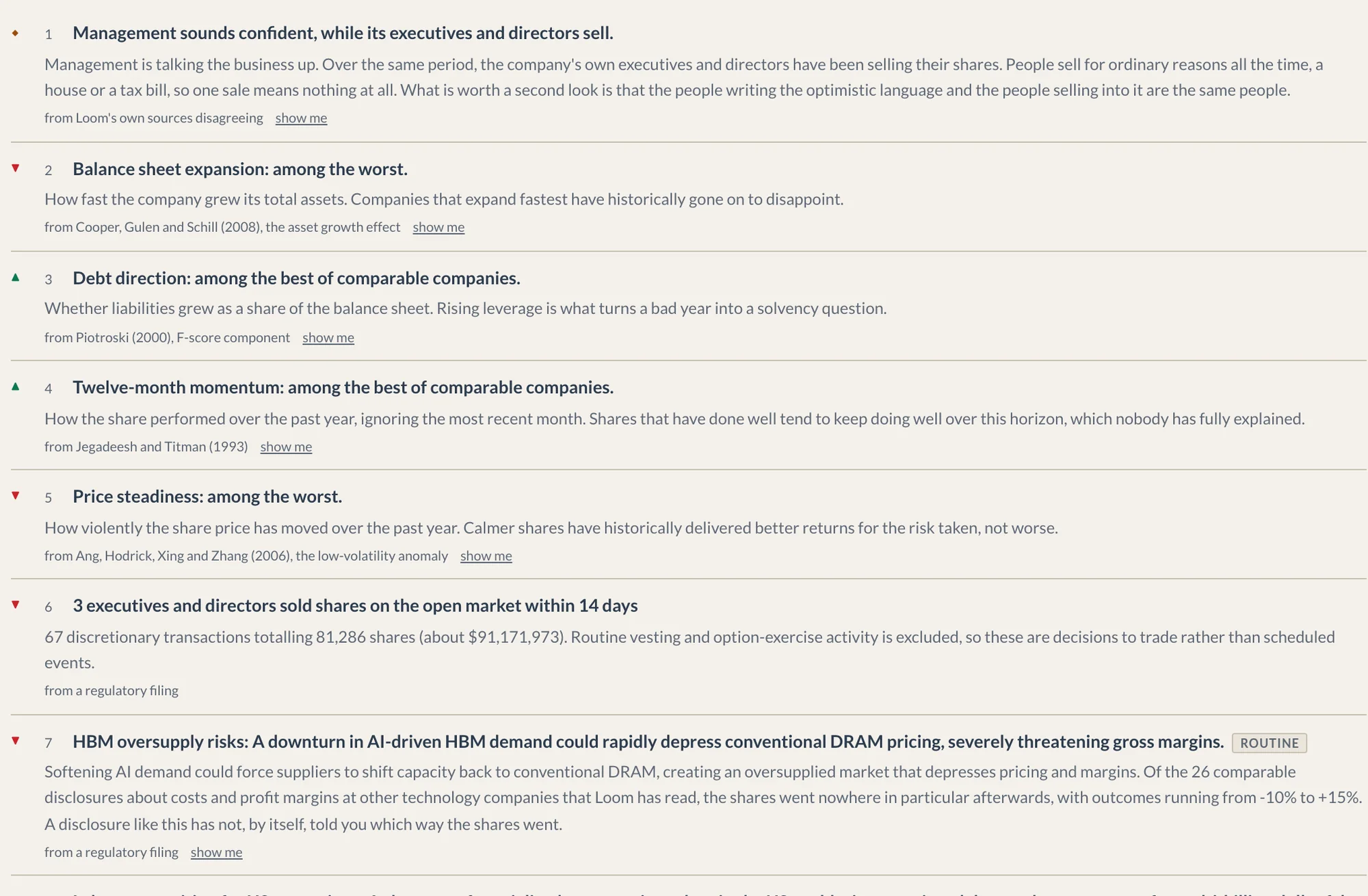
Averaging a confident earnings call with heavy selling by its executives would hide the most interesting thing about them. Loom reports the tension itself, names both sources and keeps it apart from everything else.
Loom also names the best argument the other way, and it compares filings in both directions, so a risk that a company quietly stopped mentioning is reported as clearly as a new one.
Micron's ranked findings open with a disagreement between management's tone and its executives' share sales.
Loom shows the best argument the other way beneath the findings.
Loom can show you any past day exactly as it was known on that day.
Every document and every figure is stored with the date it became public. Ask about a past date and Loom answers only with what was on file then, so you can test your reasoning against what you could actually have known.
The quarter ends, and the company starts preparing its figures.
The figures are filed, and Loom records the day they became public.
You ask about this day, and you see the figures as they were first filed.
A figure is restated later, and the restatement cannot rewrite the earlier day.
Restatements resolve to the date you ask about.
A figure restated later is shown as first filed for any day before the restatement.
Prices are read strictly backwards.
Price history for a past date uses only the closes that existed by then, so no later move leaks into an earlier view.
Rankings are stored with their dates.
A question about last spring returns the ranking that existed last spring.
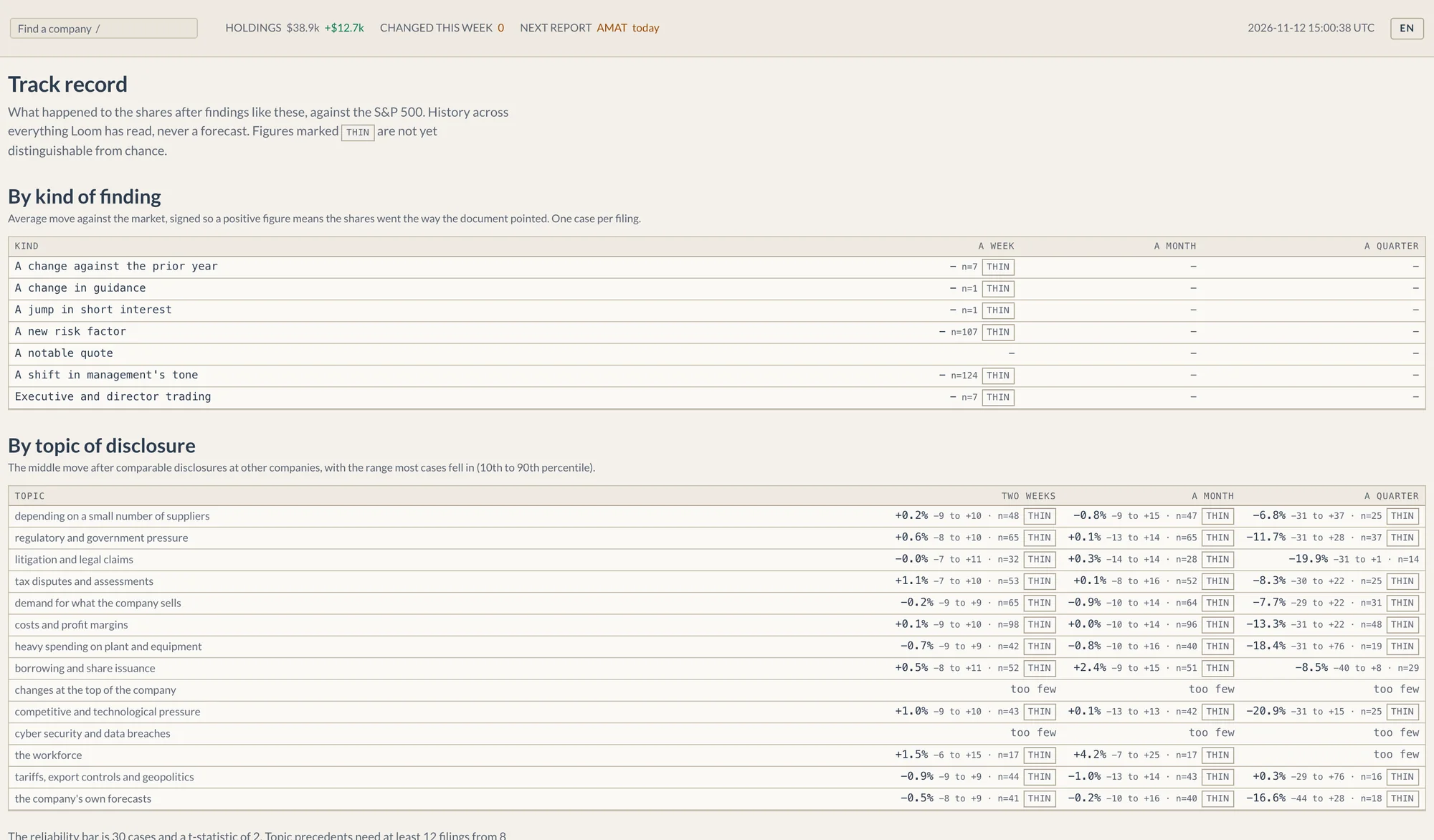
Loom publishes what happened after its own findings, even when the answer is nothing.
For each kind of finding, Loom shows how shares moved against the market in the weeks and months that followed, and it marks every result that is too thin to trust.
Most of the figures on Loom's Track record page were marked thin on 12 November 2026, and Loom shows them anyway.
You can open any finding and follow it to the filing.
Every finding in Loom carries its passage and a link to the original document, so the check takes one click.